
Navigating Big Emotions
31 May 2026

If there is one thing that is universal when raising children, it’s the notion that at some stage or another in your parenting journey you will encounter some big emotions from your child!
This is a completely normal part of your child’s development. While you may feel alone at times, please know that every parent or caregiver will experience this at some stage during their parenting journey.
Understanding why these moments happen and having some simple strategies up your sleeve can help make these moments feel less daunting.
Emotional Safety
Navigating big emotions with your child can feel challenging, especially when it feels as though they save these moments just for you!
One positive to hold fast to during these moments is that you have created a safe space for your child where they can express their emotions. It is extremely common for children to hold onto all their emotions throughout the day and then release them when they return to the people they feel safest with.
Understanding your child’s brain development
You may have heard of the importance of a child’s first 1000 days. This is because during the first 1000 days their brains are developing and creating connections at a rapid speed. This brain development shapes how they feel, think and respond to people, places and things.
A Simple Brain Model
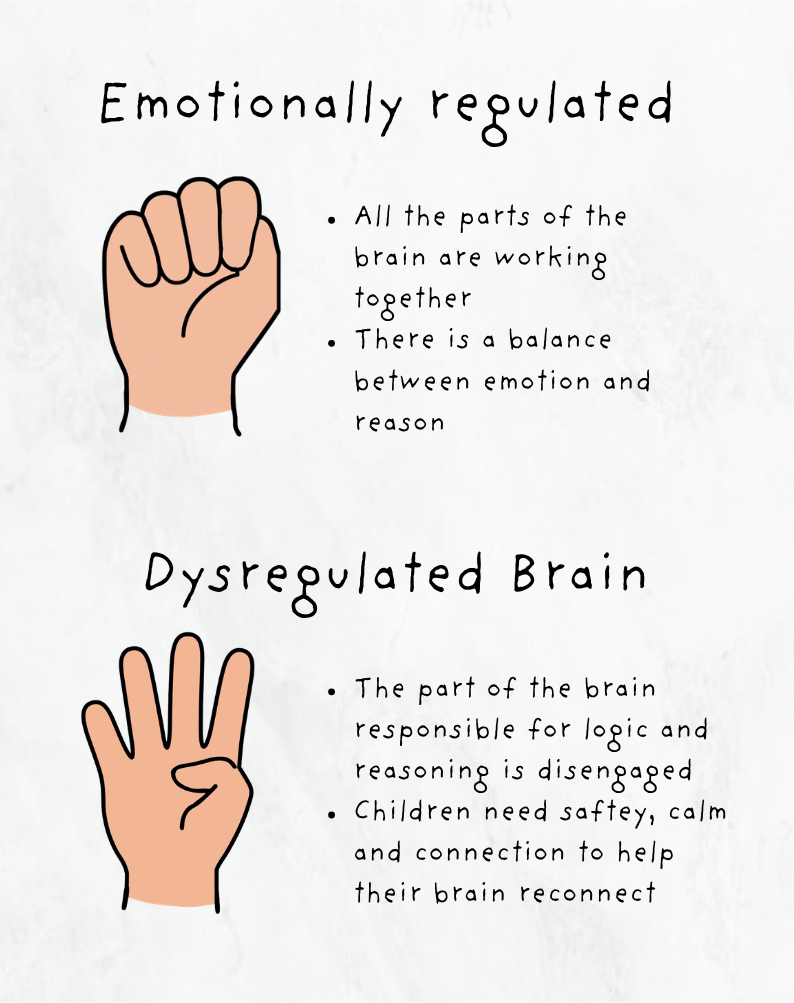
Dr. Dan Siegel uses a hand as a visual representation of a brain.
In his model, the palm of your hand represents a brainstem. This brainstem is responsible for basic survival functions such as breathing, your heart rate and the overall feeling of safety.
If you then cross your thumb over your palm this represents the brains limbic system. The limbic system is responsible for feelings, emotions, your memories and also for your fight/flight/freeze or fawn responses.
Your fingers then represent the prefrontal cortex. This is the part of the brain that helps us to to think, to plan and to be able to reason and stay in control.
When you fold your fingers down over your thumb this represents a brain that has all the parts connected, the limbic system is working collectively with the prefrontal cortex and there is a balance between emotion and reason.
As parents and caregivers, we know that children don’t always exist within this state though, and it can feel like they can move from emotionally regulated to dysregulated at record speed!
Using the hand model, this is described as flipping the lid. If you raise your fingers, this models a brain with the prefrontal cortex (logic and reasoning) disengaged and the limbic (emotional) system taking centre stage. Children in this state aren’t able to think clearly or reasonably and need safety, calm and connection to help their brain ‘reconnect’ again.
Connection Before Correction
When emotions are running high, it is natural to want to jump straight into correcting your child’s behaviour. However, children learn best when they feel safe and connected.
This might sound like:
"You're feeling really upset because your tower fell down” or "you didn't want to leave the playground. That feels hard."
Acknowledging a child's feelings by responding warmly (whilst holding boundaries), does not mean agreeing with their behaviour, it is simply communicating that their emotions are valid and that you are there to help them through them.
Once your child feels calm and connected, their thinking brain can begin to come back online. This is when they are much more able to listen, learn and problem-solve with you.
It’s important to remember that your child isn’t being deliberately ‘naughty’ when they are experiencing dysregulation, their behaviour simply reflects their developmental stage.
The Power of Co-Regulation
Children are not born knowing how to regulate their emotions, instead they learn this skill through repeated experiences of being regulated by the adults around them in a process called co-regulation.
When your child is overwhelmed, your calm presence becomes an emotional anchor for them.
Sometimes this may look like:
- Sitting quietly beside your child, letting them know gently that you are present.
- Offering a cuddle (sometimes children in heightened states will refuse and that is okay, keeping your body language open such as open palms can keep the invitation open without pressure).
- Using a calm and steady voice - if your child is yelling try whispering, sometimes this can pique their curiosity and often they will pause yelling to try hear the whisper.
- Naming what you can see happening.
- Taking a few slow breaths together (see the next section on some breathing games you could try with your child).
Over time, these repeated experiences help children develop their own ability to regulate emotions all by themselves!
Breathing Games for Children Under Five
Fun and playful breathing exercises can be a wonderful way to help children reconnect with their bodies and calm their nervous systems. Help your child to learn these games when they in a good space as the part of their brain used for learning and reasoning is ‘offline’ during moments of dysregulation.
Smell the Flower, Blow Out the Candle
Invite your child to pretend they are smelling a beautiful flower.
Take a slow breath in through the nose.
Then pretend to blow out a birthday candle with a long gentle breath out.
Teddy Bear Breathing
Encourage your child to lie down with a teddy on their tummy. As they breathe in and out they can watch their teddy go up and down. How high can they make their teddy go up? How slow can they lower them back down again?
Bee Breathing
Take a breath in through the nose and then hum/buzz like a bee as you slowly breathe out.
The vibration can be calming and children often find it fun.
The Evolve Promise
At Evolve Education we understand the importance of your child’s emotional development and we promise to work collaboratively to support your tamariki to be confident, happy, curious and independent.
Please reach out to your child’s kaiako if you have any questions at all about your child’s learning and development. We also warmly invite you to share your aspirations and learning goals for your child.

Taking Responsibility
Children are born confident and capable learners, constantly seeking opportunities to explore, make decisions, and do things for themselves. In this blog, we share some practical ways whānau can nurture their child's independence, responsibility and agency, helping them to build the confidence and resilience they need to thrive both now and as they transition on to school or kura.
Read more

Learning to Problem-Solve through Junk Play
What if everyday household items could become powerful learning tools for your child? Junk play transforms simple materials such as cardboard boxes, lids, tubes and fabric scraps into opportunities for creativity, critical thinking and imaginative play. In early childhood education, junk play helps children develop problem-solving, communication, collaboration and fine motor skills while encouraging curiosity and independent learning. Discover why this open-ended play experience is so valuable for children's development and how you can support learning through play at home and in your local Evolve Education early learning centre.
Read more

Pathways to School and Kura
Starting school or kura is a significant milestone for both children and parents. While many families focus on early academic skills, research and educators agree that confidence, curiosity, resilience, communication, and independence are the foundations of a successful transition. Discover how everyday play and simple home activities can help your child develop the lifelong learning skills they need to thrive at school and beyond.
Read more
