Te Whāriki for Whānau
30 January 2026

As a parent, navigating the world of Early Childhood Education can often feel daunting, and at times, it may seem like you’re trying to grasp an entirely new language, one that may even differ from centre to centre based on their unique philosophies!
However, there is one common thread among all early learning services in New Zealand: they all follow a bicultural early childhood curriculum called Te Whāriki.
Te Whāriki is internationally known for it’s unique emphasis on “our bicultural foundation, our multicultural present and the shared future we are creating” (Ministry of Education, 2026). It is a highly regarded and celebrated curriculum that champions an inclusive approach to early learning
The holistic nature of Te Whāriki
Te Whāriki literally translates to ‘the woven mat’ and this metaphor illustrates how all the components in Te Whāriki are interwoven, creating a holistic view of children’s learning and development.
The principles and strands in Te whāriki
Te Whāriki is underpinned by four broad principles:
Kotahitanga | Holistic development
Highlights the idea that a child's learning and growth are interconnected.
Whānau tangata | Family, whānau and community
Recognises the importance of strong connections between children, their families, and the wider community.
Whakamana | Empowerment
Focuses on nurturing children's confidence, independence, and ability to make choices.
Ngā hononga | Relationships
Recognises the importance of kaiako building strong, supportive connections with children, their families, and kaiako around them.
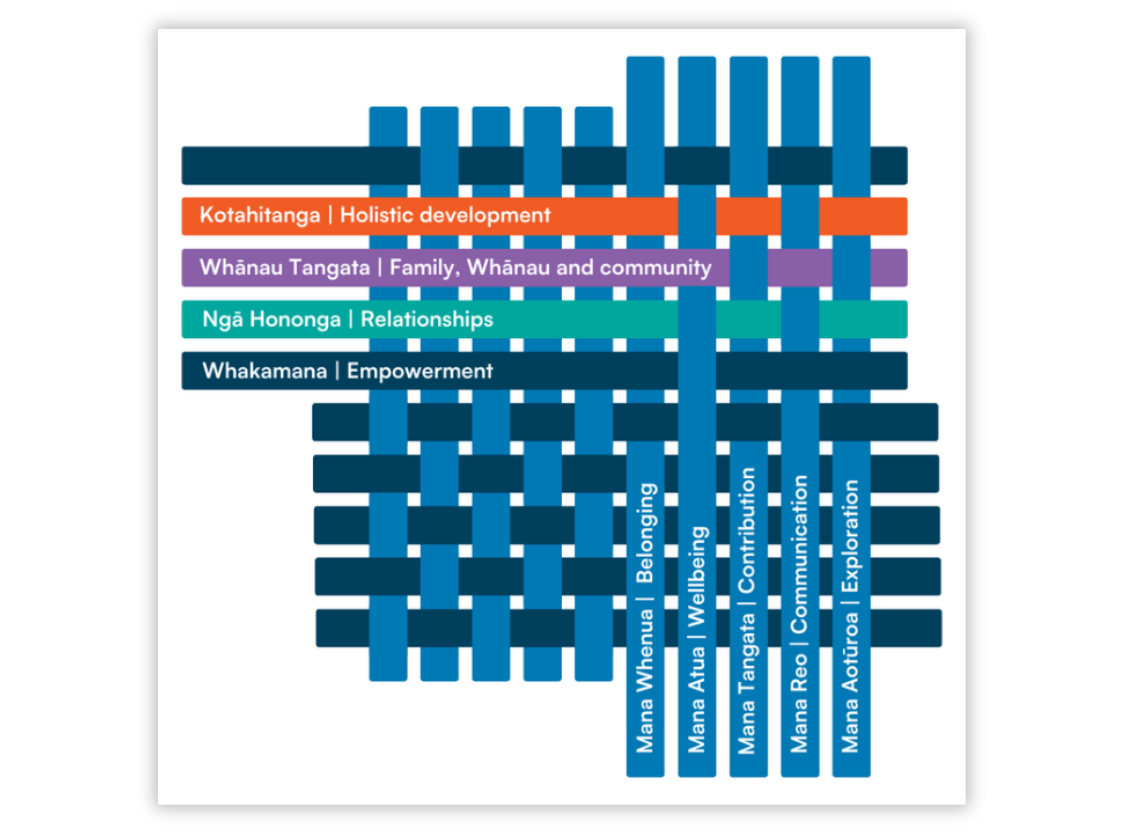
The principles are then interwoven with five strands to provide a framework that guides kaiako planning and how they plan for individual child’s learning alongside whānau.
The five strands are:
Mana whenua | Belonging
Emphasises the importance of children knowing that they have a place where they are accepted and valued.
Mana atua | Wellbeing
Focuses on ensuring that children are physically and emotionally safe, healthy, and happy.
Mana tangata | Contribution
Supports children to learn with and alongside others, appreciating diversity and understanding their role in different communities.
Mana reo | Communication
Focuses on supporting children to develop the skills to express themselves, understand others, and learn new languages and literacies including languages of maths and the arts.
Mana aotūroa | Exploration
Encourages children to learn about their world through play and discovery.
All five of these strands recognise the importance of children’s social and emotional learning alongside their physical and intellectual development.
How is Te Whāriki used by early learning centres?
Te Whāriki is not a step-by-step instruction guide for kaiako, rather it is a framework that encourages them to consider the interests, strengths and needs of each individual child as well as the goals whānau and wider community have for them.
Within each strand of Te Whāriki is a set of broad and flexible learning outcomes. Kaiako use these to analyse, interpret what they are observing and plan for future learning pathways.
Each learning outcome begins with "over time and with guidance and encouragement, children become increasingly capable of" which recognises that each child has their own individual learning journey and the role of the kaiako is to help them take the next step.
Te Whāriki also underpins our Evolve Promise, if you would like to know more about the Promise and how we implement Te Whāriki at Evolve please click here to find out more about our curriculum.

Keeping things Consistent
In a time where there is a lot of instability and unknowns within in our communities, it is more important than ever to protect our children’s sense of security and belonging. One of the ways that this can be achieved is by keeping things consistent, but what does this really mean and what are the benefits of this for your child?
Read more

The Magic of Twigs, Stones and Leaves: using natural materials in your child's play
In a world where ‘educational’ toys and equipment are promoted heavily across different media settings it seems important to share some of the very real ways that you can help support your child’s learning and development through the use of natural materials which are easier both on the planet as well as on your wallet!
Read more

Holiday Ideas
The end-of-year holidays can be a big change for young children and whānau. Discover simple, low-cost activity ideas that support routines, connection and wellbeing during this busy time.
Read more