
The Magic of Twigs, Stones and Leaves: using natural materials in your child's play
20 February 2026

In a world where ‘educational’ toys and equipment are promoted heavily across different media settings it seems important to share some of the very real ways that you can help support your child’s learning and development through the use of natural materials which are easier both on the planet as well as on your wallet!
Maths Learning
Natural resources are a fantastic way to weave those all important mathematical skills into your child’s play.
Although children will naturally explore these concepts on their own and in their own way, if you are looking to take a more hands on approach, some ways that you can support your child with mathematical concepts could include:
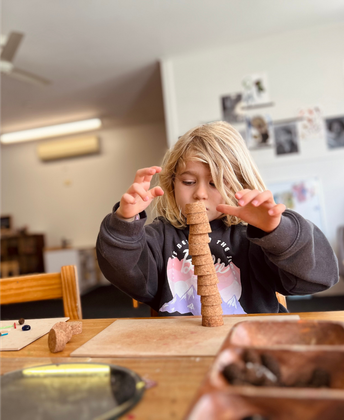
Arranging items together in order of smallest to largest or heaviest to lightest can introduce measurement and numeracy concepts. How can they tell which objects are heavier?
Similarly, creating patterns with items in certain orders can help support your child with patterning skills. Can your child recognise a pattern you create and guess what would come next? Can they create their own pattern for you to guess?
And of course, counting objects together as well as adding in some addition and subtraction aspects can also support your child with maths learning.
You may find that your child may not be interested in this area of learning yet and that’s okay! There is no need to push them as when they are interacting with items such as natural materials, they are already learning a multitude of maths skills as they naturally play.
Imagination and creativity
Natural Materials are an incredibly flexible learning resource! They can be used in many different ways and children have an innate ability to use their imaginations to create play experiences beyond what we can imagine!
And of course a comparison needs to be added here to the ‘educational toys’ that most of the time can only be used in one way and can be limiting on children’s imaginations.
Provide sticks, stones and leaves alongside playdough, pop a basket of acorns or pinecones on the floor, anything at all and let your child amaze you with what they can imagine. If your child needs some support with their creative thinking you can always you can always encourage this by using ‘I wonder’ sentence starters such as “I wonder what we could create with these stones”, “I wonder if I can create some art with these leaves” or “I wonder what this stone reminds me of” (did we mention they are a great tool to keep our adult imaginations on point too!).
Communication
Natural resources with their open ended nature can also encourage children to explore ideas and theories through their play. It is a fantastic way for children to communicate the inner workings of their minds even if they don't have the language to describe it. As children get older they often invite others into their play where they can then begin to communicate these ideas with others and vice versa.
Emotional regulation
Natural resources have incredible sensory properties, they all have different sizes, textures, weights and smells which can be both calming and grounding for younger and older children alike.
The unstructured nature of natural materials also offer a sense of freedom and control that can be soothing especially as they focus their attention to their play in their own way.
Wonder and respect for the natural world
Not only are natural materials fun for children to play with but they are also fun to collect! Walks through parks or reserves provide a fantastic opportunity not only for collecting natural resources but also gives children much needed time and space in nature.
While you are walking and collecting you could wonder out loud about what you can see, hear and feel to encourage your child to also take in the magic of the natural world.
It is also never too early to teach children how to protect and nurture nature.
Ways that this can be done is talking with children about the importance of bees and how they can help bees by leaving flowers to grow for the bees, the role of leaves in a tree’s life cycle and only collecting leaves that have fallen from the trees or have been pruned.
Fine motor development
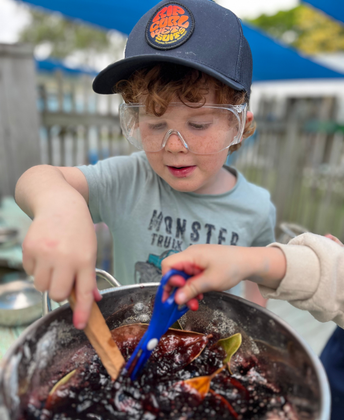
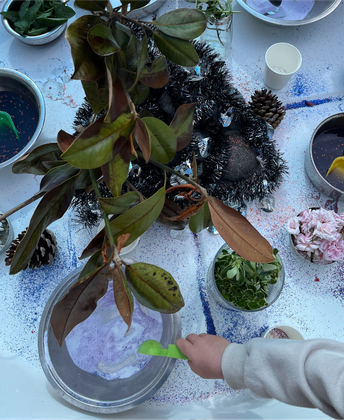
When children engage with natural materials and use them in their play they are also further developing their fine motor skills. Every movement helps develop control and coordination of their hands and fingers, these skills are vital for children when they begin to learn to write!
Important considerations when exploring and engaging with natural materials.
As with any new play experience we introduce to our children, there are of course considerations to keep in mind.
Supervision
Lots of natural materials are small in size or can have peices easily broken off from them. Always take into consideration your child’s age and/or developmental stage and ensure that children who still place objects in their mouths are provided with larger, safer materials and that children are actively supervised when exploring and playing with natural materials.
Toxicity
Because natural materials also include sticks, leaves and sometimes flowers, it is important to first ensure that they are safe for children to engage with. Some plants and trees can of course be toxic to children and pets.
Being aware of these risks and being able to identify plants can ensure that children are kept safe from harm.
The use of AI can be beneficial for plant identification through reverse image searches and plant identification apps.
Another handy resource to refer to from a New Zealand lens can also be found by clicking here
The Evolve Promise
At Evolve early learning centres we promise to offer a curriculum that fosters your child’s ability to be creative, to generate new and innovative ideas, and to problem-solve solutions to challenges.
Providing natural materials and opportunities for children to engage and learn with them is just one of the ways that our promise is brought to life for our children across Aotearoa.
To find out more about the Evolve promise please visit the curriculum section of our website by clicking here

Keeping things Consistent
In a time where there is a lot of instability and unknowns within in our communities, it is more important than ever to protect our children’s sense of security and belonging. One of the ways that this can be achieved is by keeping things consistent, but what does this really mean and what are the benefits of this for your child?
Read more

Te Whāriki for Whānau
As a parent, navigating the world of Early Childhood Education can often feel daunting, and at times, it may seem like you’re trying to grasp an entirely new language, one that may even differ from centre to centre based on their unique philosophies! However, there is one common thread among all early learning services in New Zealand: they all follow a bicultural early childhood curriculum called Te Whāriki.
Read more

Holiday Ideas
The end-of-year holidays can be a big change for young children and whānau. Discover simple, low-cost activity ideas that support routines, connection and wellbeing during this busy time.
Read more